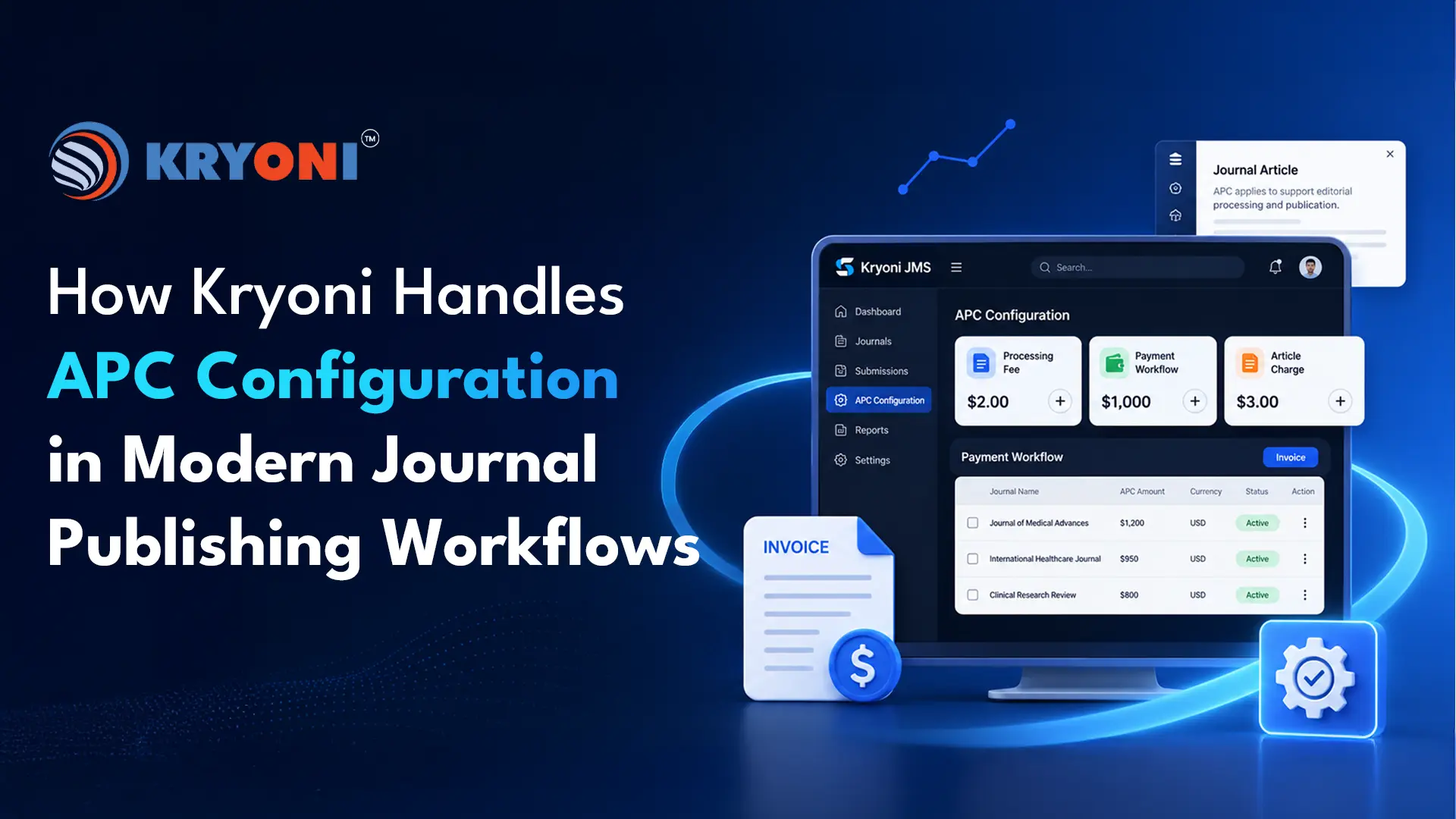
How Kryoni Handles APC Configuration in Modern Journal Publishing Workflows
11 Jun 2026
A Structured Approach to Pricing, Payments, Waivers, and Invoicing
In scholarly publishing, Article Processing Charges (APCs) have become a core component of open access and hybrid journal models. However, managing APCs manually across multiple journals, article types, and author categories often leads to inconsistencies, delayed invoicing, and increased administrative burden.
As publishing operations scale, these challenges can significantly affect workflow efficiency and financial accuracy. Editorial and finance teams need a reliable way to apply journal policies without introducing disconnected processes or repeated manual checks.
To address this complexity, the Kryoni Journal Management System (JMS) provides a structured and intelligent APC configuration framework that brings precision, automation, and policy-driven control into the publishing ecosystem.
The system ensures that APC handling is not treated as an isolated financial task but as an integrated part of the editorial and production workflow.
The Challenge of APC Management in Scholarly Publishing
APC policies can vary considerably across journals and publication models. A publisher may need to manage different charges according to:
Journal or publication title
Article type
Standard or fast-track processing
Author or institutional category
Funding agreements
Regional payment requirements
When these rules are maintained through spreadsheets, email instructions, or separate billing tools, publishers may encounter inconsistent fees, missed payment requests, incorrect invoices, and limited visibility into financial status.
A scalable APC process requires centralized configuration, clear triggering rules, controlled adjustments, and complete transaction records.
Dynamic APC Configuration Engine
Within Kryoni JMS, APC configuration operates as a dynamic pricing engine rather than a static fee setup.
Publishers can define APC rules for different publishing scenarios, including:
Standard manuscript submissions
Fast-track processing
Different article categories
Journal-specific pricing policies
Institutional or author-based arrangements
This rule-driven model allows publishers to manage complex pricing structures from a centralized environment while ensuring that the correct charge is applied to each manuscript.
Flexible Payment Method Configuration
Publishers can configure preferred payment methods according to institutional requirements, operational policies, and regional compliance needs.
Supported payment approaches can include:
Online payment gateways
Offline bank payments
Manual payment confirmation
Institution-managed payment processes
This flexibility allows the APC workflow to adapt to diverse publishing environments without disrupting editorial operations.
Authors can complete payment through the configured online gateway, allowing the system to record transaction status and update the manuscript workflow.
When an institution or region requires offline payment, authorized teams can verify the transaction and update its status within the same centralized system.
Flexible APC Triggering Across Workflow Stages
One of the key strengths of Kryoni JMS is its ability to define when APCs are triggered within the manuscript lifecycle.
Publishers can configure APC activation at different workflow stages, such as:
Manuscript submission
Peer-review completion
Final acceptance
Production
This stage-based approach ensures that payment requests align with the publisher's editorial policies and preferred business process.
Example: APC Trigger at the Production Stage
If APC payment is configured to trigger at the production stage, the system activates the payment workflow only after the manuscript has successfully passed peer review and received final acceptance.
A typical workflow follows these steps:
The manuscript completes peer review
The editor records the final acceptance decision
The manuscript moves into production
Kryoni JMS activates the configured APC rule
The author receives a payment notification
Payment is completed online or recorded offline
The payment status is updated within the manuscript record
This trigger mechanism aligns financial processing with editorial decisions and removes uncertainty about when an APC should be requested.
Waiver and Discount Governance
Financial governance within Kryoni JMS is strengthened through integrated waiver and discount management capabilities.
Editorial teams and authorized administrators can apply:
Full APC waivers
Partial discounts
Institutional pricing adjustments
Funding-based reductions
Customized publication charges
These adjustments can support institutional agreements, funding mandates, regional policies, or strategic publication priorities.
By managing exceptions within the same platform, publishers avoid informal approvals and disconnected records.
Transparency and Audit Readiness
Every waiver, discount, payment update, and pricing adjustment is tracked within the system.
A structured financial record can include:
The configured APC amount
Applied waiver or discount details
The authorized user responsible for the adjustment
Payment method and current status
Invoice and transaction information
Relevant timestamps and workflow events
This traceability supports compliance requirements and strengthens accountability across editorial, administrative, and finance teams.
Automated Billing and Invoice Management
After manuscript acceptance and APC processing, Kryoni JMS automates the billing lifecycle.
Publishers can generate and download invoices directly from the system without relying on separate tools or repeated manual data entry.
The automated invoice workflow provides:
Invoice generation based on configured APC rules
Accurate inclusion of approved waivers or discounts
Real-time payment status updates
Downloadable invoice records
Simplified financial reconciliation
By tightly integrating editorial workflows with financial operations, the system reduces discrepancies, delays, and administrative overhead.
A Unified Publishing Financial Workflow
Kryoni JMS transforms APC management from a fragmented administrative process into a unified, policy-driven workflow.
The platform brings together:
Pricing configuration
Workflow-based APC activation
Online and offline payment processing
Waiver and discount governance
Invoice automation
Payment tracking and reconciliation
This unified approach ensures that financial activities remain connected to the manuscript, editorial decision, and publication stage.
Benefits for Publishers and Authors
Configured rules help ensure that journals apply APC policies consistently across manuscripts and publication cycles.
Automated triggers, notifications, status updates, and invoices reduce repetitive coordination between editorial and finance teams.
Centralized pricing and adjustment records reduce the risk of incorrect fees, duplicate requests, and reconciliation errors.
Authors and authorized teams gain clearer visibility into charges, discounts, payment requirements, and transaction status.
Publishers can manage increasing article volumes and multiple journal policies without proportionally increasing administrative effort.
Conclusion
Article Processing Charges are an important part of modern open access and hybrid publishing, but they should not create fragmented workflows or unnecessary administrative complexity.
Effective APC management requires more than a static fee field. Publishers need configurable pricing, workflow-based payment triggers, controlled waivers, flexible payment methods, automated invoicing, and complete financial traceability.
Kryoni JMS provides this structure by integrating APC management directly into the manuscript lifecycle. Publishers can align financial policies with editorial decisions while maintaining accuracy, consistency, and accountability.
This policy-driven approach gives publishers greater transparency, scalability, and operational efficiency while ensuring that authors experience a smooth, predictable, and professional publication journey from submission to final publication.